Articles
Read our latest articles and guides.

Your Comprehension Is Perishable Too
Understanding, once built, doesn't stay built. The store you'd convert is fully retrievable now and slightly harder to reach every year it sits unused.

Coverage, Not Levels
Vocabulary count, hours studied, levels, streaks — every one can climb substantially while your ability to hold a conversation stays exactly where it was.

The Friend Who Orders For You
Ten days of continuous exposure and your total production is "thank you", four times. Nobody agreed to the arrangement — it just formed on the first evening.
Grammar Last
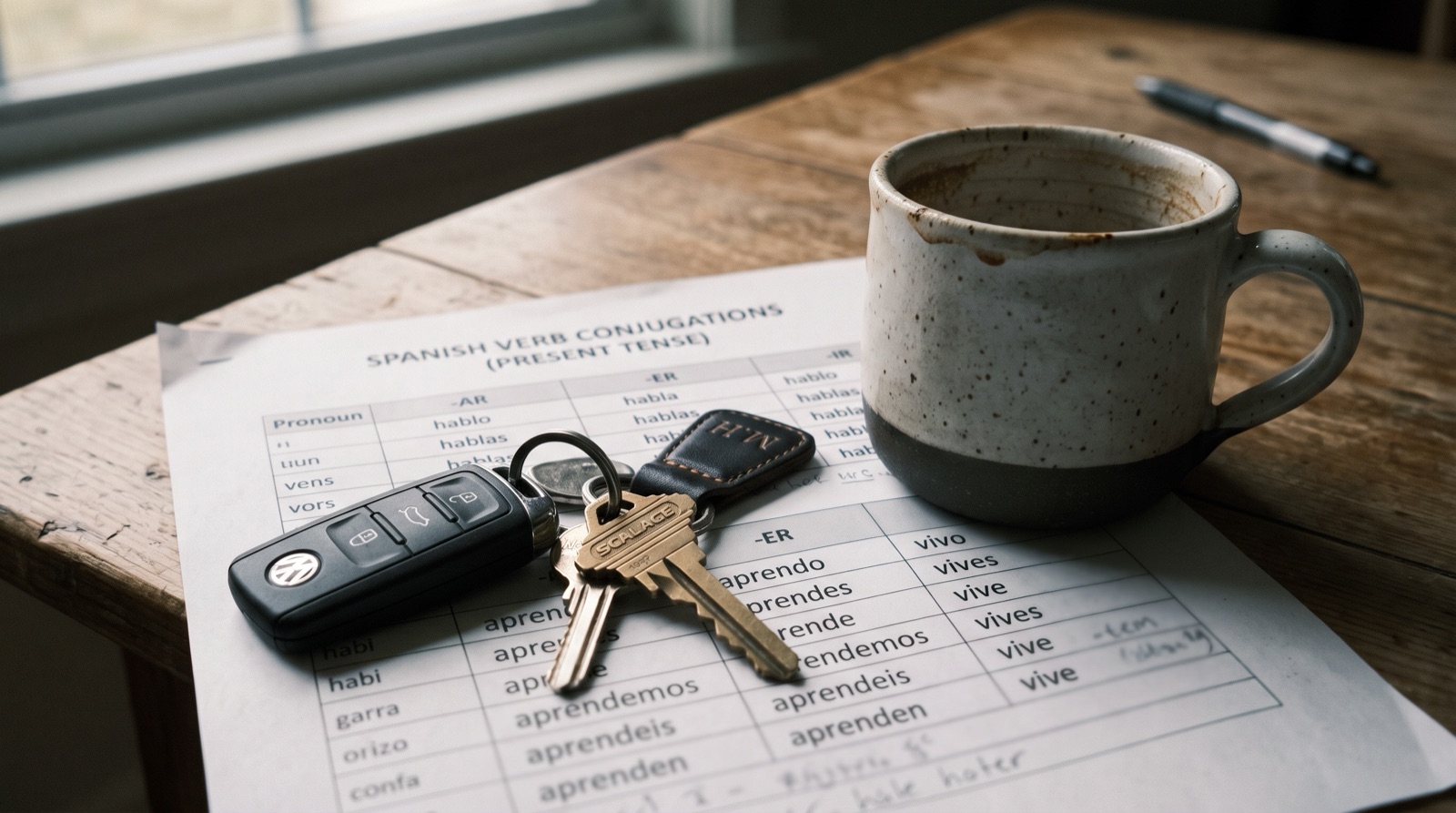
Every course runs present, past, future, conditional. That order exists because grammar is easy to examine, not because it's how anyone learns to speak.

The Second Language You Already Learned This Way
You can sing a line in a language you never studied, at full speed, years later. Every part of that process worked. Only the meaning was ever missing.

What Language Teachers Already Agree On
Underneath the arguments about tenses and correction, there's a set of things almost no language teacher disputes — and they're more useful than the controversies.

The Gap Doesn't Close on Its Own
The assumption is that if you keep going, speaking eventually turns up. It doesn't — not because you aren't doing enough, but because the activity doesn't produce it.

Singing Is Physiotherapy for Your Mouth
Speech is one of the most complex physical acts your body performs, and it's being taught as an academic subject. That mismatch is why you fall apart at speed.

Talking to Your Grandparents
A person speaking a second language is working with a smaller instrument. The version of them you know may be the compressed one — and it's about a hundred phrases away.

Nobody Cares What Level You Are
B1. A2. Upper intermediate. Try walking up to somebody and saying "I'm B1." The CEFR was built for institutions to compare certificates — none of that was ever your problem.