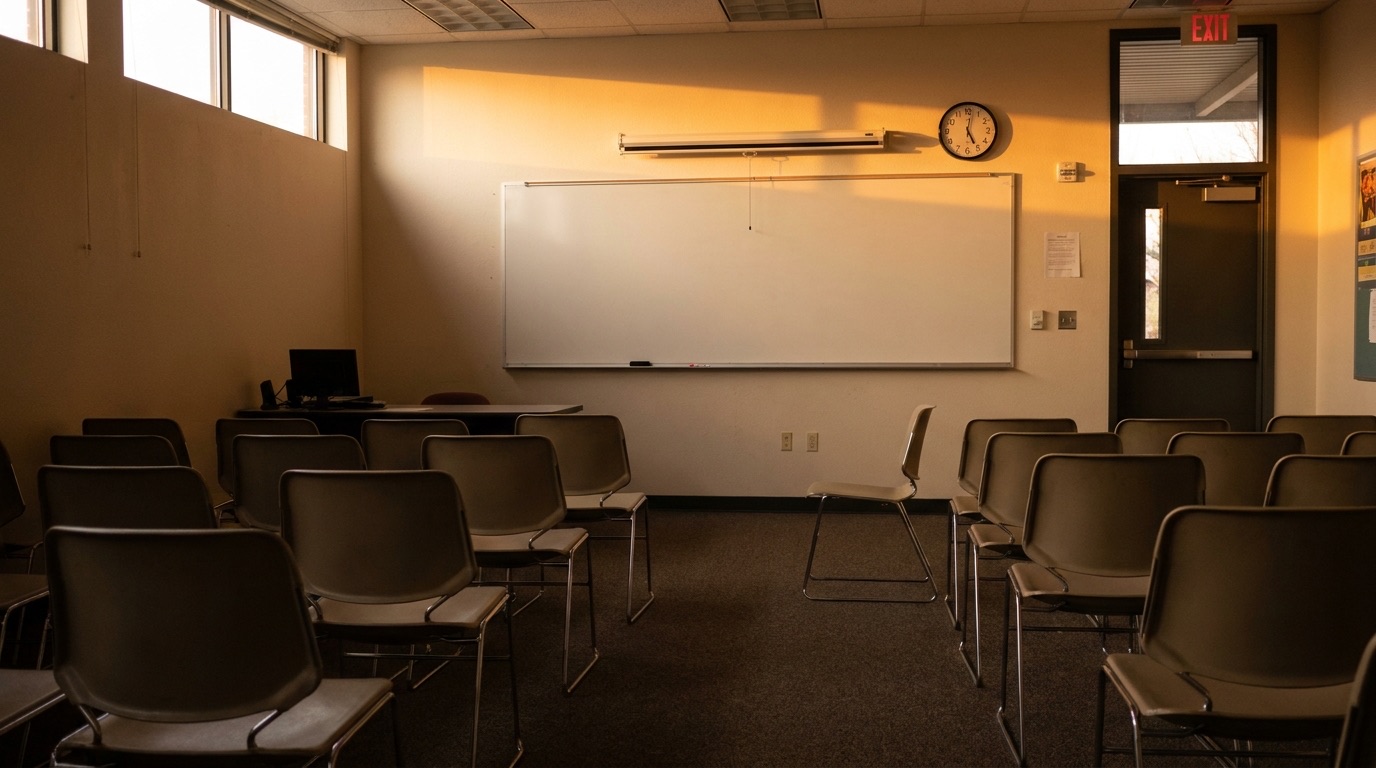
The moment someone decides to get serious about a language, they go looking for a class.
Evening course. Community centre. Online group with a fixed slot on Tuesdays. It feels like the responsible move — a room, a teacher, a timetable, other people expecting you to turn up.
You've done this before. It was called school.
What a Class Is Optimised For
A class has to serve fifteen people at once, and that single constraint decides everything else about it.
It moves at a pace nobody in the room chose. It covers material in an order set before you enrolled. It drifts toward whatever can be marked on paper, because it has to be assessable. And it happens at a fixed hour whether or not that's an hour your brain is available.
Now do the arithmetic on speaking time. Ninety minutes, fifteen learners, a teacher who has to explain, correct and manage the room. Your share of actual production is about four minutes — most of it reading a prepared line aloud to strangers.
Four minutes a week. Nobody has ever learned to speak in four minutes a week.
The Room Is the Problem, Not the Teacher
Most language teachers are good at their job. That isn't the issue.
The issue is that speaking in front of a group of adults who are all silently grading your accent is one of the most reliable ways to shut down production ever devised. You hesitate. You self-edit. You choose the sentence you can definitely get right over the one you actually meant. You go quiet and hope the teacher moves on.
An hour of that leaves you tired, faintly humiliated, and no more able to speak than when you walked in. Then you pay for another one.
What You're Really Buying
Be honest about it. A class buys you a commitment device — money down and a slot in the diary, so you turn up on the days you don't feel like it.
That's a real thing to want. But you're buying discipline, not language, and paying a lot for it.
There's a cheaper way to get the same thing: pick a method you'd do anyway. Not one you have to be marched to.
On Your Own Terms
No timetable. No room. Nobody waiting for your answer while you work out the verb.
You produce language on your commute, in your kitchen, in the car, at whatever hour your brain actually wakes up. You repeat the parts you want to repeat as many times as you want, and nobody sighs. You get it wrong constantly and there's nobody there to see it.
The speaking practice in a week of that isn't four minutes. It's hours.
You don't need permission, a syllabus, or a Tuesday.
About Outputly
Outputly is 100 songs in the Outputly app, with lyric videos to learn them from. No timetable, no classroom, nobody listening. You sing along wherever you already are, and the phrases keep looping after the headphones come off.