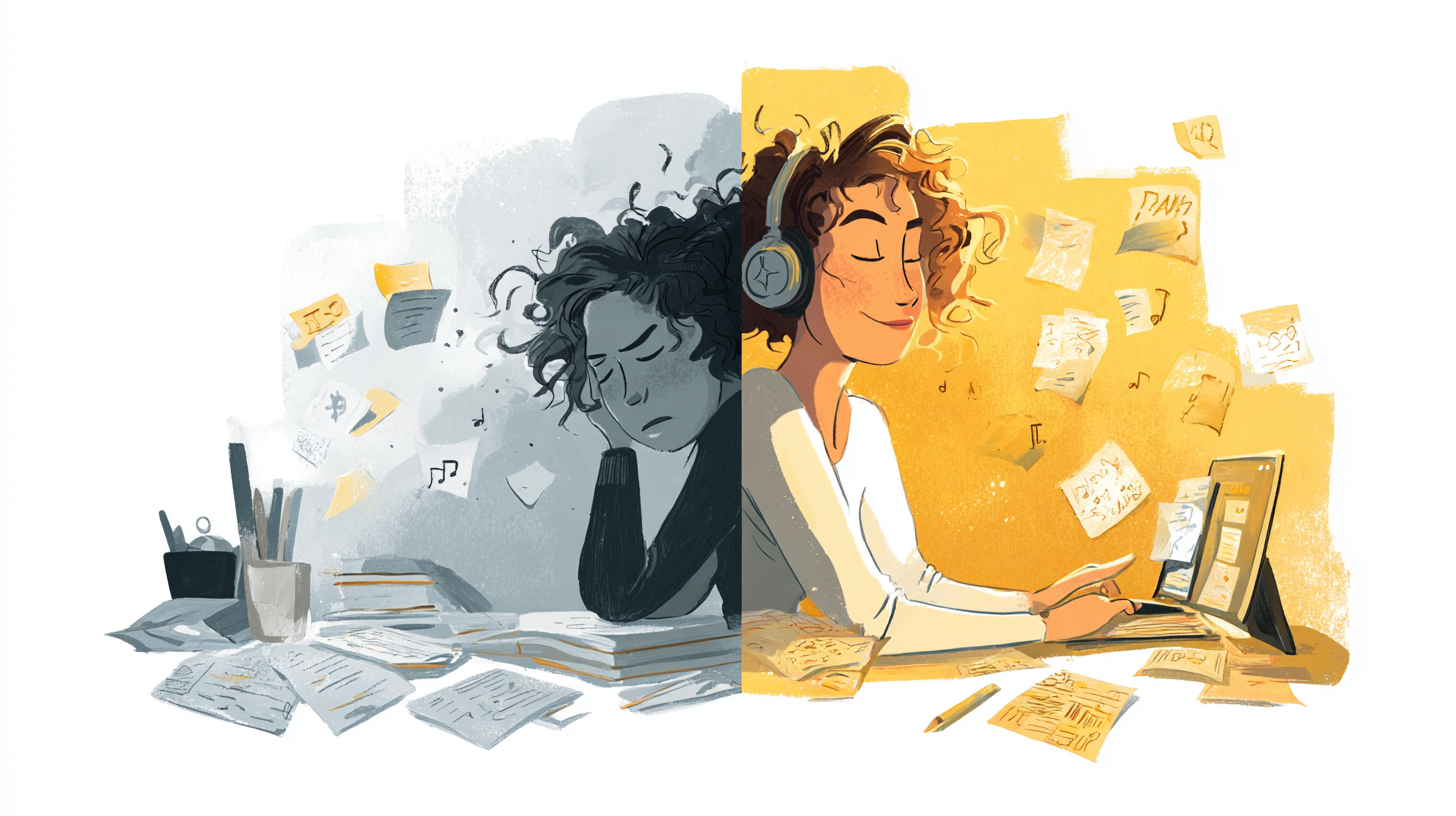
Be honest. How long do you actually last on flashcards?
Five minutes? Ten? Maybe fifteen on a good day?
You sit down with Anki or your flashcard app, full of determination. Today is the day you'll finally get through your deck. You flip the first card. "Casa." House. Flip. "Perro." Dog. Flip. "Hablar." To speak. Flip.
Three minutes in, your mind is somewhere else. You're thinking about dinner. Checking your phone. Staring at the wall. The cards keep coming but you've stopped caring. By minute five, you're done. You close the app, feel guilty, and tell yourself you'll try harder tomorrow.
Tomorrow, the same thing happens.
Now think about the last time you listened to music. How long did that last? Thirty minutes? An hour? Two hours on a long drive? Did you have to force yourself? Did you set a timer? Did you feel guilty about stopping?
Of course not. Music doesn't require willpower. You don't have to discipline yourself to listen. Your brain wants to keep going.
That difference — five minutes of flashcards versus an hour of music without thinking — isn't a discipline problem. It's a brain chemistry problem. And understanding it changes everything about how you should be learning a language.
Your Brain on Flashcards
When you review flashcards, your brain is performing a specific cognitive task: retrieval practice. You see a prompt, search your memory for the answer, evaluate whether you got it right, and move on. It's a process managed entirely by your Thinking Brain — the declarative memory system that handles facts and conscious recall.
Retrieval practice is effective for memorisation. The research on spaced repetition is genuine — testing yourself at increasing intervals does strengthen memory. Nobody disputes this.
But effective doesn't mean engaging. And here's the problem: your Thinking Brain operates without emotional reward. It processes information logically, methodically, and completely devoid of pleasure. There's no dopamine hit when you correctly recall that "mesa" means "table." Your brain doesn't care. It processed the information and moved on.
Without emotional engagement, your brain has no incentive to continue. There's no pleasure signal saying "keep going." There's no reward pathway lighting up. There's nothing pulling you forward. The only thing keeping you on the flashcards is willpower — and willpower is a finite resource that depletes rapidly.
This is why you last five minutes. Your brain is doing exactly what it's designed to do: conserving energy by disengaging from an activity that provides no reward. It's not laziness. It's neuroscience.
Your Brain on Music
When you listen to music you enjoy, a completely different neurological process occurs.
Salimpoor et al. (2011) at McGill University demonstrated that music triggers dopamine release in the nucleus accumbens — the brain's primary reward centre. This is the same neurochemical pathway activated by food, physical affection, and other fundamental pleasures. Your brain doesn't just process music. It rewards you for experiencing it.
And it doesn't stop there. The dopamine release happens not just when you hear a pleasurable moment in a song, but in anticipation of it. Your brain learns the structure of a song and releases dopamine slightly before the satisfying parts arrive. This creates a continuous loop of anticipation and reward that sustains engagement for extended periods.
This is why you can listen to music for an hour without trying. Your brain is being continuously rewarded. There's no willpower required because the activity is intrinsically pleasurable. Your Feeling Brain — the system that controls emotions, reward, and pleasure — is fully engaged.
The contrast is stark. Flashcards: zero emotional reward, willpower-dependent, engagement collapses in minutes. Music: continuous emotional reward, intrinsically motivating, engagement sustains for hours.
Why Engagement Duration Matters
Language learning isn't a sprint. It's an accumulation of exposure, repetition, and practice over time. The method that wins isn't the most efficient per minute — it's the one you actually do consistently for long enough to make a difference.
A flashcard system that's theoretically optimal but that you abandon after five minutes delivers less total learning than a music-based method that you happily engage with for an hour. Five minutes of perfect retrieval practice versus sixty minutes of musical exposure and production. The maths isn't close.
And it compounds. If you use flashcards, you'll do five reluctant minutes today, skip tomorrow, do three minutes the day after, then forget for a week. If you listen to language-learning songs, you'll play them for an hour today, relisten on your commute tomorrow, have them on while cooking the day after, and hum them in the shower all week.
The flashcard user studies in deliberate sessions and stops when the session stops. The music user has the song running through a day that was happening anyway. Over a month the totals are not close, and they are not close by a margin no amount of study efficiency recovers.
The Repetition Problem
Flashcard advocates argue that spaced repetition is the key to long-term memory. And they're right that repetition matters. Seeing a word once won't make it stick. You need to encounter it multiple times over increasing intervals.
But flashcards make repetition painful. Every review session is a conscious act of discipline. You have to decide to open the app, force yourself through the deck, and resist the urge to quit. Every repetition costs willpower.
Music makes repetition invisible. You don't "decide" to repeat a song. You just play it again because you enjoy it. Or the earworm repeats it for you involuntarily. A catchy song might loop in your head dozens of times in a single day — and each loop is a repetition that strengthens the memory.
Research by Williamson et al. (2012) found that most people experience earworms regularly. These involuntary musical loops are your brain repeating content without any conscious decision to do so. It's spaced repetition without the suffering.
You'd never voluntarily review a flashcard forty times in one day. But an earworm will replay a phrase forty times before lunch.
What Flashcards Train vs What Music Trains
There's a deeper problem with flashcards beyond boredom: they train the wrong brain system for speaking.
Flashcards train your Thinking Brain. You see a prompt, consciously retrieve the answer, and evaluate it. This strengthens declarative memory — your ability to recall facts.
But speaking doesn't use declarative memory. Speaking uses procedural memory — your Knowing Brain. When you speak your native language, you don't retrieve words from a mental flashcard deck. You produce language automatically, without conscious recall.
Flashcards can make you better at recognising vocabulary. They can help you pass a written test. But they don't train the automatic production system that handles real conversation. Knowing that "quiero" means "I want" when you see it on a card is a fundamentally different brain process than saying "quiero un café" spontaneously at a restaurant.
Music trains the Knowing Brain directly. When you sing along to a song, you're producing language — not just recognising it. The motor patterns of speech are being practised. And because the Feeling Brain is active (dopamine, pleasure, reward), the transfer from conscious knowledge to automatic production is accelerated.
Flashcards give you facts. Music gives you skills.
The Anxiety Factor
There's one more dimension where flashcards fail and music succeeds: emotional association.
Flashcards are associated with study, obligation, and failure. Getting a card wrong feels like a small defeat. The mounting pile of overdue reviews creates guilt. The app's streak counter creates pressure. Over time, the emotional association with flashcards becomes negative — your brain associates the activity with stress and inadequacy.
Music creates the opposite association. It's linked to pleasure, relaxation, and enjoyment. There's no failure state when singing along to a song. Getting a word wrong just means you sing it differently next time. There's no guilt, no overdue pile, no streak to protect.
Krashen's Affective Filter Hypothesis tells us that negative emotions block language acquisition. If flashcards make you feel stressed and guilty, your brain's filter goes up and less learning occurs. If music makes you feel relaxed and happy, the filter stays down and more learning occurs.
The method that feels better isn't just more enjoyable. It's more effective.
The Real Discipline
Language learners are often told they need more discipline. More willpower. More grind. If the flashcards are boring, push through. Success requires suffering.
This is terrible advice. Not because discipline doesn't matter, but because the best learning system is one that doesn't require discipline at all. If you have to force yourself to learn, your Feeling Brain is disengaged, your affective filter is up, and your brain is actively working against you.
The real discipline isn't forcing yourself to do something painful. It's choosing a method that your brain actually wants to engage with — and then letting it.
You don't need more willpower. You need a different method.
An hour of music without thinking will always outperform five minutes of flashcards through gritted teeth. Your brain knows this. It's time you listened to it.
About Outputly
Outputly replaces the flashcard grind with earworm songs. You press play, you sing along, and your Feeling Brain does the rest. No willpower required. No overdue decks. No guilt.
Every song teaches you 4 high-frequency chunks that combine into 30+ real phrases. The earworms repeat them involuntarily throughout your day. And because music activates your Feeling Brain, the transfer from Thinking to Knowing happens faster than any flashcard system can deliver.