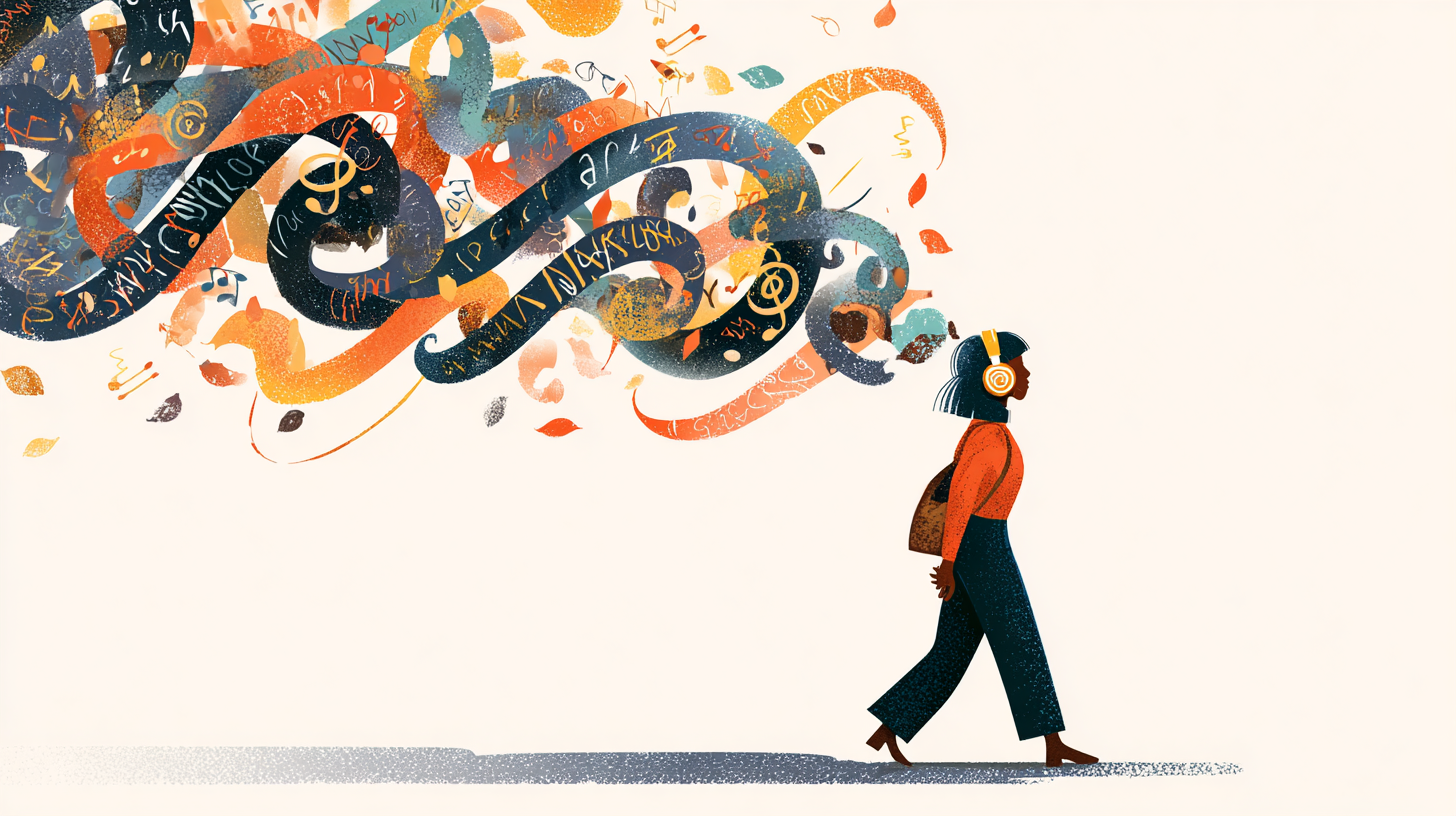
You know the feeling. A song gets stuck in your head and loops for hours. In the shower. At work. Lying in bed. You didn't choose to think about it. You can't make it stop. The melody and lyrics just keep playing on repeat.
Most people find earworms mildly annoying. But if that song happened to be in a language you're learning, something remarkable would be happening inside your brain.
What Earworms Actually Are
The scientific term for earworms is involuntary musical imagery (INMI). Research by Williamson et al. (2012) found that the vast majority of people experience them regularly — catchy songs that replay involuntarily in the mind, sometimes for hours at a time.
But earworms aren't just idle mental noise. When a song loops in your head, your brain is actively processing it. Brain imaging studies have shown that involuntary musical imagery activates many of the same neural regions as actually listening to or producing the music — including motor areas responsible for speech production.
In other words, when a song is stuck in your head, your brain is rehearsing the physical production of those sounds. Not just remembering them. Rehearsing them. The motor cortex fires as if you were actually singing.
Why This Matters for Language Learning
If the song stuck in your head contains phrases in your target language, your brain is doing something extraordinary: it's practising speech production automatically, involuntarily, and repeatedly — without any conscious effort from you.
Consider what this means in terms of the three brain systems.
Your Thinking Brain stores the facts — the vocabulary and grammar you've learned. Your Knowing Brain handles automatic production — the ability to speak without thinking. Your Feeling Brain accelerates the transfer between them.
An earworm activates all three simultaneously. The Feeling Brain stays engaged because the music triggers pleasure and reward pathways. The repetition pushes the language from conscious recall (Thinking Brain) toward automatic production (Knowing Brain). And it happens involuntarily — you don't have to discipline yourself to practise.
No flashcard system in the world can compete with this. You'd never voluntarily repeat "quiero un café" fifty times in a day. But an earworm will do it for you, effortlessly, while you're doing the washing up.
The Research Behind Musical Memory
The relationship between music and memory has been studied extensively. Ludke et al. (2014) at the University of Edinburgh found that singing foreign language phrases leads to significantly better recall than speaking or reading the same phrases. The musical context creates a richer, more deeply encoded memory.
Salimpoor et al. (2011) demonstrated that music triggers dopamine release in the brain's reward system — the same neurochemical pathway activated by food and other pleasurable experiences. This means that musical learning isn't just more effective; it's more rewarding at a neurochemical level. Your brain wants to repeat it.
And Särkämö et al. (2008) showed that music listening enhances cognitive recovery and mood, suggesting that music creates a neurological environment that's broadly more conducive to learning and memory formation.
The combination is powerful: music creates stronger memories, triggers reward pathways that make you want to repeat the experience, and generates earworms that practise production involuntarily.
Why Nobody Talks About This
Despite the research, earworms are almost never discussed in language learning circles. The comprehensible input community focuses on listening and reading. The traditional education system focuses on grammar and vocabulary. Even output-focused methods tend to emphasise conversation practice and writing exercises.
Music-based language learning exists but is often dismissed as a novelty — something for children or casual learners. This is a mistake. The neuroscience is clear: musical encoding creates deeper, more accessible, and more production-ready memories than any other format.
The earworm isn't a side effect. It's the most powerful language learning mechanism available.
How to Use Earworms Strategically
Not all songs become earworms. Research suggests that songs are more likely to get stuck when they have a simple, repetitive melodic pattern, they're heard recently and frequently, they have a moderate tempo, and they have clear, singable lyrics.
This means the most effective musical language learning isn't just listening to pop songs in your target language. The songs need to be specifically designed with language learning in mind — using high-frequency vocabulary, clear pronunciation, progressive difficulty, and melodies engineered to stick.
The learning sequence matters too. Research on dual coding theory suggests that seeing the lyrics while hearing the song creates significantly stronger encoding than audio alone. And actively singing along — rather than passively listening — engages the motor systems that are essential for speech production.
The optimal approach is: learn the song through a lyric video (visual + audio encoding), sing along actively (motor skill training), then let the earworm do its work throughout your day (involuntary production rehearsal). When you want to reinforce, relisten in the app to reactivate the loop.
About Outputly
Every Outputly song is engineered to become an earworm. Our lyric videos pair visual and audio encoding. You sing along to activate motor production. And the earworms train your Knowing Brain on repeat throughout your day — without effort.
100 earworm songs. 3,000+ phrases. 95% conversational coverage.