You've done everything right.
Hundreds of hours of Dreaming Spanish. A 500-day Duolingo streak. Netflix shows with subtitles. Podcasts on your commute. Maybe classes too. You've followed the advice — get more input, get more input, get more input.
And it worked. You understand a lot. When someone speaks to you, you follow the conversation. You can read articles, watch videos, and catch most of what's being said.
But when you open your mouth to respond, nothing comes out.
You freeze. You stammer. You revert to your native language. You know the words — you've seen them hundreds of times — but you can't produce them at conversational speed.
If this sounds familiar, you're not alone. It's one of the most common frustrations in language learning. And the reason it happens has nothing to do with how hard you've studied. It has to do with which part of your brain you've been training.
Stephen Krashen and the Input Hypothesis
In the 1980s, linguist Stephen Krashen proposed a set of ideas that would reshape language education for decades. His most influential claim, the Input Hypothesis, stated that we acquire language by understanding messages — by receiving what he called "comprehensible input."
The idea was elegantly simple: expose yourself to language that you can mostly understand, at a level just slightly above your current ability (what Krashen famously labelled "i+1"), and your brain will naturally acquire the language over time.
Krashen argued that speaking ability would emerge on its own as a result of sufficient input. You didn't need to practice speaking. You didn't need grammar drills. You just needed to understand enough messages, and the rest would follow.
This was revolutionary. It shifted language education away from rote memorisation and grammar translation toward something much more natural — listening, reading, and absorbing language in context. Comprehensible input methods like Dreaming Spanish, LingQ, and immersion-based approaches are all built on Krashen's foundation.
And for input, he was right. Comprehensible input is genuinely effective at building understanding. If you've spent hundreds of hours listening to and reading your target language, your brain has absorbed an enormous amount of vocabulary, grammar patterns, and intuitive feel for the language.
Your understanding is real. That part worked.
The Problem Krashen Didn't Solve
But Krashen made one claim that millions of learners have tested — and found wanting.
He said that output — speaking and writing — is a result of acquisition, not a cause of it. He argued that you don't need to practice speaking to learn to speak. If you just get enough input, speaking will emerge naturally.
For many learners, it hasn't.
The forums, subreddits, and language learning communities are full of people who followed Krashen's advice faithfully. They consumed thousands of hours of comprehensible input. They built impressive understanding. And then they tried to have a conversation — and froze.
"I can understand my target language perfectly but I can't speak it" is possibly the most common sentence in language learning. It describes millions of learners worldwide who have plenty of input but zero output ability.
So what went wrong? If Krashen was right about input, why doesn't speaking emerge on its own?
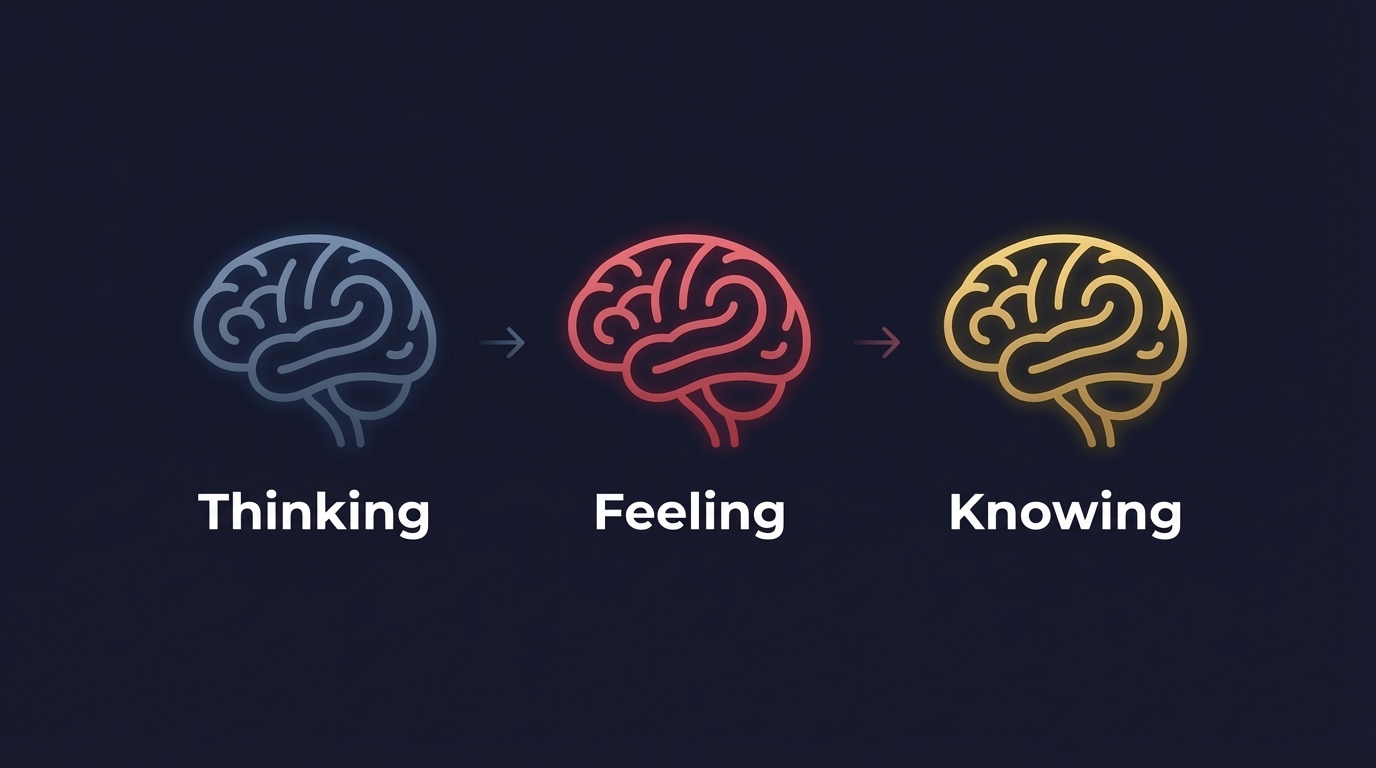
Your Brain Has Three Parts That Matter
To understand why input alone doesn't produce speakers, you need to understand how your brain processes language. And it's simpler than you might think.
Your Thinking Brain
When you learn vocabulary through an app, study grammar rules in a textbook, or absorb language through comprehensible input, all of that information goes to what we call your Thinking Brain.
Your Thinking Brain is where facts and logic live. It stores declarative knowledge — things you know and can recall. "Casa means house." "The past tense of ir is fui." "In French, adjectives come after the noun."
Every language learning method you've ever used — Duolingo, Babbel, Dreaming Spanish, classes, textbooks, Netflix — has been filling your Thinking Brain. And it's done a great job. Your Thinking Brain is probably overflowing with knowledge about your target language.
But here's the problem: when you want to speak, your Thinking Brain has to retrieve each word, conjugate it, build a sentence, and get the word order right. That's a multi-step conscious process. It works — but it takes several seconds. In a real conversation, you have a fraction of a second.
Your Thinking Brain is simply too slow for conversation.
Your Knowing Brain
There's a completely different part of your brain that handles automatic, unconscious actions. We call this your Knowing Brain.
Your Knowing Brain is where skills live — things you can do without thinking about them. Riding a bike. Tying your shoes. Typing on a keyboard.
And crucially: speaking your native language.
When you speak your native language, you don't recall vocabulary. You don't conjugate verbs consciously. You don't plan sentence structure. Words come out in the right order, correctly formed, at conversational speed — all without any conscious thought. That's your Knowing Brain at work.
Neuroscientists call this procedural memory. It's the same system that lets you ride a bike without thinking about pedals, balance, and steering. Once something is in your Knowing Brain, it's automatic.
Here's the critical insight: your target language has never been trained in your Knowing Brain. All those hours of comprehensible input filled your Thinking Brain with facts about the language. But facts don't become automatic skills on their own. You can't think your way to fluency.
Your Thinking Brain and your Knowing Brain are separate systems. Information doesn't automatically transfer from one to the other, no matter how long you've known it. A fact you've known for ten years is still a fact — it won't spontaneously become an automatic skill.
This is what Krashen got wrong. He assumed that enough input would naturally lead to output. But input fills the Thinking Brain. Output requires the Knowing Brain. And the Knowing Brain has to be trained separately.
Your Feeling Brain
There's a third part of your brain that changes everything: your Feeling Brain.
Your Feeling Brain controls emotions, reward, and pleasure. And it plays a critical role in how quickly information moves from your Thinking Brain to your Knowing Brain.
Research has consistently shown that learning which engages emotions and reward pathways consolidates faster and more deeply than emotionally neutral learning. When something feels good, your brain prioritises it for long-term storage and procedural consolidation.
This is why certain experiences stick in your memory effortlessly while others require constant revision. The emotional component — your Feeling Brain — determines how quickly and deeply your brain locks information in.
Your Feeling Brain is the accelerator. When it's active, the transfer from Thinking to Knowing speeds up dramatically. When it's dormant — as it is during flashcard drills, grammar exercises, and most passive input — the transfer barely happens at all.
Why Speaking Is a Motor Skill
There's another dimension to this problem that Krashen's theory completely overlooks: speaking is physical.
When you speak, your mouth, tongue, jaw, lips, and breath all have to coordinate precisely to produce specific sounds in a specific sequence at a specific speed. These are motor skills — physical movements that require practice to develop.
You can understand "quiero un café" perfectly through input. But your mouth has never formed those sounds in that sequence at that speed. No amount of listening will train the physical coordination required to produce speech. That's like expecting to play piano by listening to concerts.
Motor skills develop through practice — through actually performing the movements repeatedly until they become automatic. This is another reason why input alone can't produce speakers. The physical apparatus of speech has never been trained.
What Merrill Swain Got Right
Krashen's Input Hypothesis didn't go unchallenged. In 1985, linguist Merrill Swain proposed the Output Hypothesis, arguing that producing language — not just receiving it — plays a crucial role in acquisition.
Swain observed that students in French immersion programmes in Canada had received thousands of hours of comprehensible input. Their understanding was excellent. But their speaking remained limited and error-prone.
Her conclusion: output forces learners to process language differently from input. When you have to produce a sentence, you notice gaps in your knowledge that passive comprehension never reveals. You're forced to move from understanding the general meaning to producing the specific forms.
Later research by De Bot (1992) reinforced this, arguing that speaking practice is essential for developing fluency specifically because it automates production processes. Without output practice, learners can understand but can't produce at conversational speed — exactly the experience millions of input-focused learners report.
The Solution: Training Your Knowing Brain
If the problem is that your target language is trapped in your Thinking Brain and your Knowing Brain has never been trained, the solution is clear: you need a method that specifically trains your Knowing Brain.
But not just any method. Traditional "output practice" — conversation classes, tutoring sessions, speaking drills — has its own problems. For many learners, forced speaking creates anxiety. And Krashen was right about one thing: anxiety blocks acquisition. When you're terrified of making mistakes, your brain can't consolidate anything.
The ideal method would:
Train the Knowing Brain directly — building automatic production, not just more facts
Develop the motor skills of speech — physically practising the sounds, rhythm, and flow of the language
Activate the Feeling Brain — making the process feel rewarding so the transfer accelerates
Remove anxiety — creating a safe environment for production without the fear of judgement
Use pre-built chunks — teaching ready-to-use phrases rather than individual words that need assembly
Music does all five.
When you sing along to a song in your target language, you're physically producing the sounds (motor skill training). The melody and rhythm give your mouth a template to follow (scaffolded production). The music activates your Feeling Brain (accelerated transfer). You're "just singing" so there's no performance anxiety (lowered affective filter). And songs naturally teach phrases as complete chunks, not individual words (automatic production).
Research by Ludke et al. (2014) at the University of Edinburgh found that singing foreign language phrases leads to significantly stronger recall than speaking or reading the same phrases. The musical context creates deeper encoding precisely because it engages emotional and motor systems simultaneously.
And then there's the earworm effect. Research by Williamson et al. (2012) found that the vast majority of people experience involuntary musical imagery — songs that get stuck in your head. When a language-learning song becomes an earworm, your brain rehearses speech production involuntarily, throughout the day, without any conscious effort. Your Feeling Brain keeps pushing language from Thinking to Knowing even when you're not studying.
Krashen Was Half Right
Stephen Krashen gave language learners something invaluable: the understanding that comprehensible input is essential for building language knowledge. He was right. Input works. Your understanding is real and it matters.
But he was wrong to claim that input is sufficient — that speaking will simply emerge from enough comprehension. For millions of learners, it hasn't. And the neuroscience explains why: understanding and speaking use different brain systems, and one doesn't automatically develop from the other.
The missing piece isn't more input. It's output training — specifically, training that targets the Knowing Brain through the Feeling Brain, using music as the delivery mechanism.
If you've been following Krashen's advice and you understand your target language but can't speak it, there's nothing wrong with you. Your Thinking Brain is doing exactly what it was trained to do. You just need to train a different brain.
Your Thinking Brain is full. It's time to train your Knowing Brain.
## About Outputly
Outputly is the language learning platform built on the principles in this article. We use earworm songs to train your Knowing Brain — transferring the language you already understand into automatic speech production through your Feeling Brain.
Each song is a lyric video teaching 4 high-frequency chunks set to music. You see the English, hear the target language, and sing along. The earworms do the rest — looping involuntarily throughout your day, pushing language from Thinking to Knowing without effort.
100 songs. Over 3,000 ready-to-use phrases. 95% conversational coverage. Ordered by real-world frequency so you transfer the most useful language first. Every song available in the Outputly app for daily reactivation.
References
De Bot, K. (1992). A bilingual production model: Levelt's 'speaking' model adapted. Applied Linguistics, 13(1), 1-24.
Krashen, S. D. (1982). Principles and Practice in Second Language Acquisition. Pergamon Press.
Ludke, K. M., Ferreira, F., & Overy, K. (2014). Singing can facilitate foreign language learning. Memory & Cognition, 42(1), 41-52.
Swain, M. (1985). Communicative competence: Some roles of comprehensible input and comprehensible output in its development. In S. Gass & C. Madden (Eds.), Input in Second Language Acquisition (pp. 235-256). Newbury House.
Swain, M. (2005). The output hypothesis: Theory and research. In E. Hinkel (Ed.), Handbook of Research in Second Language Teaching and Learning (pp. 471-483). Lawrence Erlbaum.
Ullman, M. T. (2001). The neural basis of lexicon and grammar in first and second language. Bilingualism: Language and Cognition, 4(2), 105-122.
Williamson, V. J., Jilka, S. R., Fry, J., Finkel, S., Müllensiefen, D., & Stewart, L. (2012). How do "earworms" start? Classifying the everyday circumstances of involuntary musical imagery. Psychology of Music, 40(3), 259-284.