Every language learner eventually hits the same wall. You understand your target language. You recognise vocabulary. You can follow conversations. But when you try to speak, your brain goes blank.
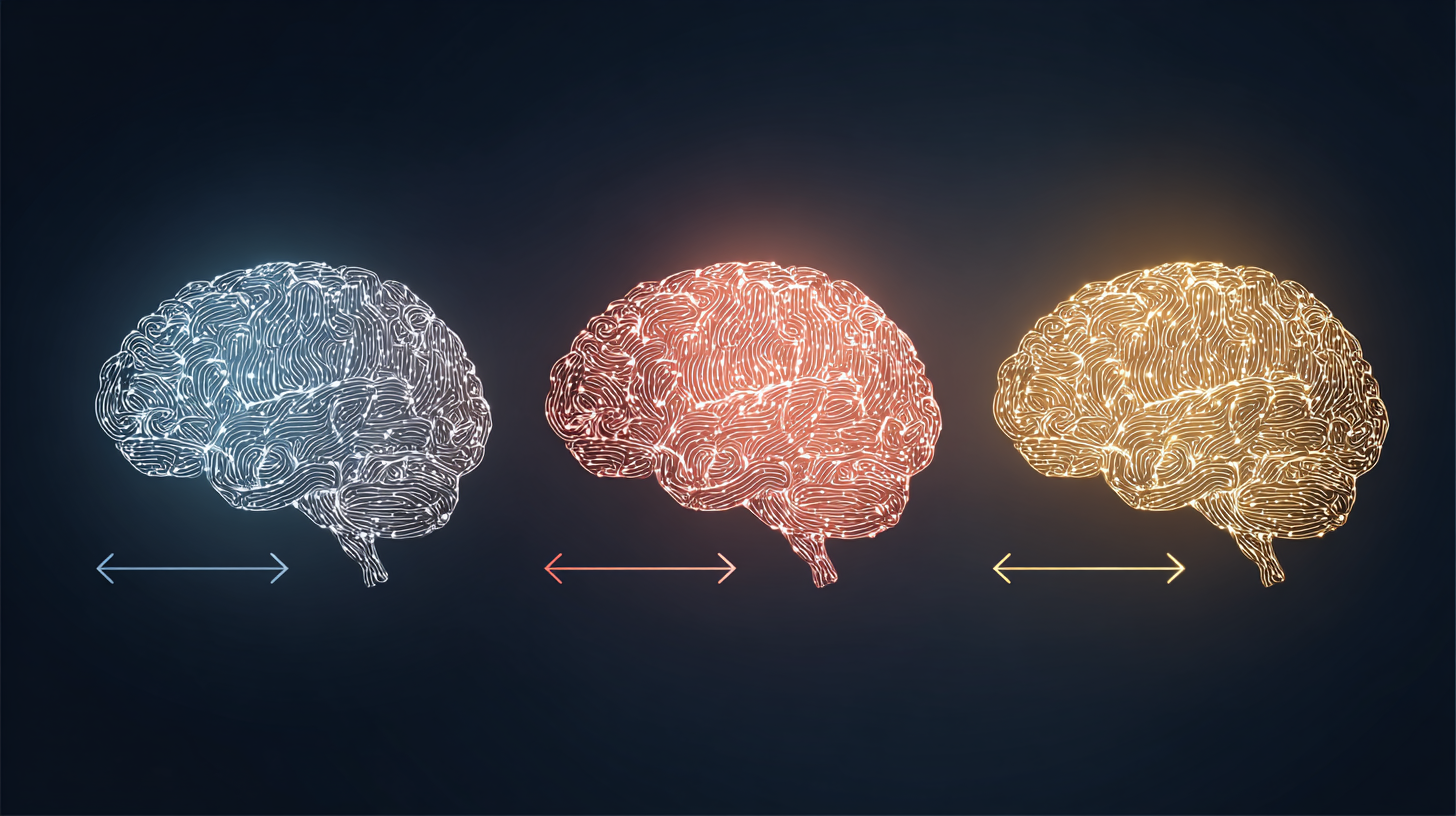
The explanation isn't motivation, talent, or study time. It's neuroscience. Your brain has three systems that each play a different role in language — and most learning methods only train one of them.
Your Thinking Brain
Your Thinking Brain is where facts and logic live. Neuroscientists call this system declarative memory, and it's responsible for storing information you can consciously recall.
When you learn that "casa" means "house" or that French adjectives follow the noun, that information goes into your Thinking Brain. It's stored as a fact — something you know about the language.
Every traditional learning method targets your Thinking Brain. Duolingo teaches vocabulary recognition. Grammar books explain rules. Comprehensible input builds understanding. Flashcards test recall. All of it goes to the same place: your Thinking Brain.
The problem emerges when you try to speak. To produce a sentence using your Thinking Brain, you have to retrieve each word, conjugate it, arrange the word order, and assemble it into a sentence. That's a conscious, multi-step process. It works — but it takes seconds. In a real conversation, you have fractions of a second.
Your Thinking Brain is essential for learning. But it's too slow for speaking.
Your Knowing Brain
Your Knowing Brain handles automatic, unconscious actions. Neuroscientists call this procedural memory — the same system that controls riding a bike, tying your shoes, or typing on a keyboard.
The defining feature of the Knowing Brain is that it operates without conscious thought. You don't think about which muscles to engage when riding a bike. You don't plan each finger movement when typing. You just do it.
Speaking your native language works the same way. When you speak English (or whatever your first language is), you don't consciously recall vocabulary, conjugate verbs, or plan sentence structure. Words come out automatically, correctly formed, at conversational speed. That's your Knowing Brain.
Your target language has probably never been trained in your Knowing Brain. All those hours of study filled your Thinking Brain with facts about the language. But facts and automatic skills are stored in different brain systems. Knowing that a verb conjugates a certain way (Thinking Brain) is completely different from being able to produce that conjugation automatically in conversation (Knowing Brain).
And here's the critical point: information doesn't automatically transfer from your Thinking Brain to your Knowing Brain. You can know a fact for years and it will never spontaneously become an automatic skill. The transfer has to be trained directly.
You can't think your way to fluency.
Your Feeling Brain
Your Feeling Brain controls emotions, reward, and pleasure. It's centred on the limbic system and is responsible for the neurochemistry that makes experiences feel good or bad.
In language learning, your Feeling Brain plays a crucial role that most methods completely ignore: it accelerates the transfer from Thinking to Knowing.
When learning is emotionally engaging — when it activates pleasure and reward pathways — your brain consolidates information faster and more deeply. Research on dopamine and learning has consistently shown that positive emotional engagement speeds up the formation of procedural memories.
Conversely, when learning is stressful, boring, or anxiety-inducing, the transfer slows down or stops entirely. This is why grammar drills feel like they never stick, why forced conversation practice can be counterproductive, and why many learners plateau despite studying consistently.
Your Feeling Brain is the accelerator. When it's active, language moves from Thinking to Knowing faster. When it's dormant, the transfer stalls.
Why This Framework Matters
Understanding these three brains explains virtually every common language learning frustration:
"I've studied for years but can't speak." Your Thinking Brain is full but your Knowing Brain has never been trained.
"I know the words but can't produce them fast enough." You're retrieving from your Thinking Brain instead of producing from your Knowing Brain.
"Language learning feels like a grind." Your Feeling Brain isn't engaged, so transfer from Thinking to Knowing is painfully slow.
"I understand native speakers but can't respond." Input filled your Thinking Brain. Output requires your Knowing Brain.
The solution isn't more input. It isn't more grammar study. It's finding a method that trains your Knowing Brain through your Feeling Brain — making the process enjoyable enough that your brain accelerates the transfer from facts to automatic production.
Music does exactly this. Songs activate the Feeling Brain through pleasure and reward. Singing produces output that trains the Knowing Brain. And earworms create involuntary repetition that continues the transfer even when you're not studying.
About Outputly
Outputly is designed around these three brain systems. Our earworm songs activate your Feeling Brain, train your Knowing Brain, and transfer the language your Thinking Brain already knows into automatic speech production.
100 songs. 3,000+ phrases. 95% conversational coverage.