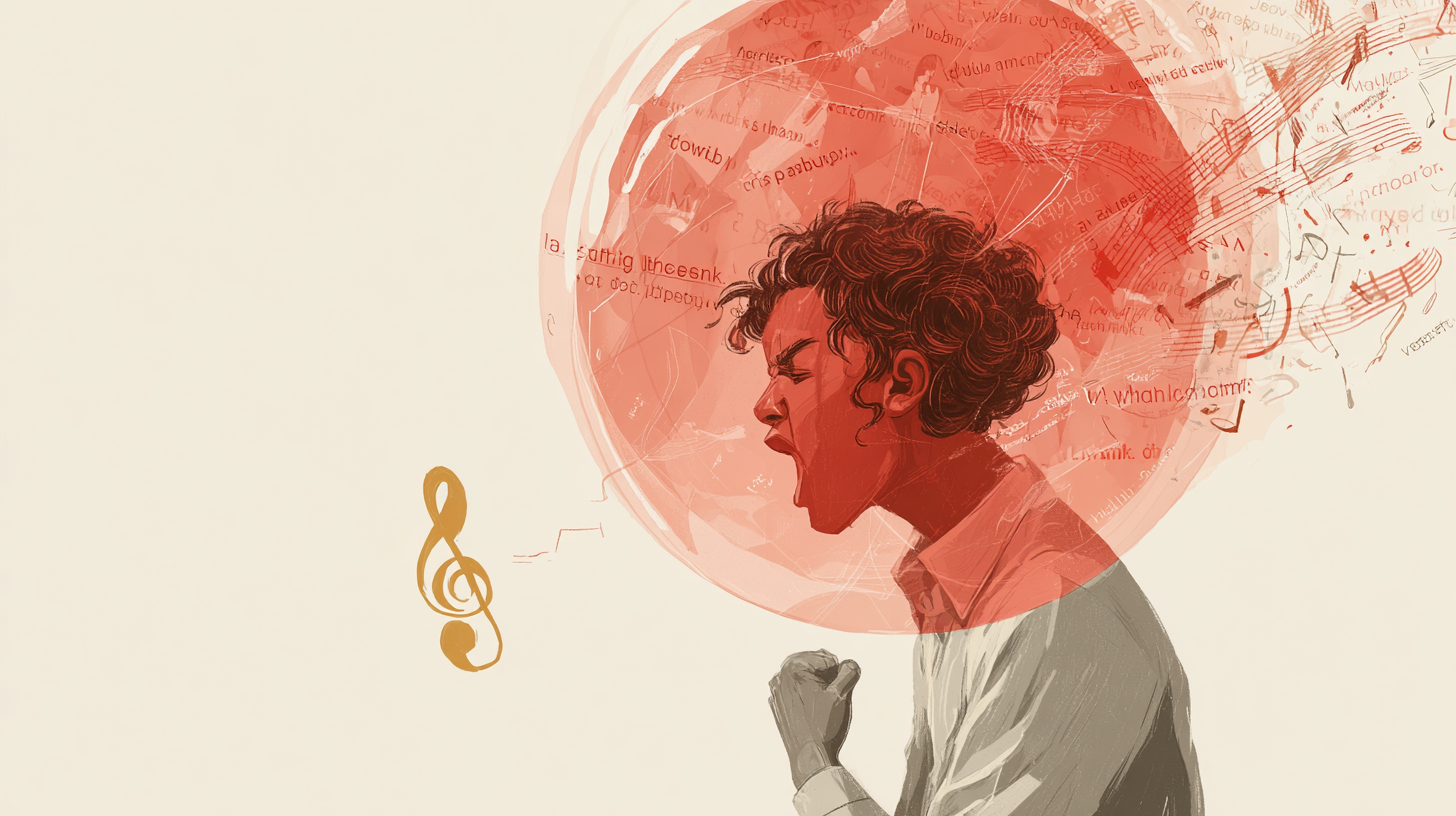
Stephen Krashen proposed many ideas about language learning, but one of his most enduring contributions has nothing to do with input or output. It's the Affective Filter Hypothesis.
The idea is simple: when a learner is anxious, stressed, or unmotivated, a mental "filter" goes up that blocks language acquisition. Even if the input is perfectly comprehensible, a stressed brain can't absorb it effectively.
Krashen applied this theory to input — arguing that learners need to be relaxed and engaged for comprehensible input to work. And he was right. Learning in a state of anxiety is demonstrably less effective than learning in a state of calm engagement.
But Krashen never applied his own theory to output. And that's where the affective filter causes the most damage.
Output Anxiety Is Real and Devastating
For most language learners, the most anxiety-inducing experience isn't listening to a podcast or reading an article. It's trying to speak.
Speaking in a foreign language puts you in a uniquely vulnerable position. You're performing in real-time. There's someone watching (and judging). You can hear your own mistakes. There's time pressure — the conversation won't wait for you to find the right word. And the stakes feel high — social embarrassment, looking foolish, confirming your fear that you "can't really speak."
Research has consistently shown that foreign language speaking anxiety is one of the strongest negative predictors of language performance. Learners who report high speaking anxiety produce less output, make more errors, and progress more slowly than learners with low anxiety — even when their underlying knowledge is identical.
The affective filter isn't just blocking input. It's blocking output. And for most learners, the output filter is far higher than the input filter.
The Vicious Cycle
Speaking anxiety creates a particularly cruel cycle. You're anxious about speaking, so you avoid speaking. Because you avoid speaking, your Knowing Brain never gets trained. Because your Knowing Brain is untrained, you perform poorly when you do try to speak. Poor performance increases your anxiety. Which makes you avoid speaking more.
Many learners stay trapped in this cycle for years. They compensate by doing more input — more Duolingo, more Netflix, more podcasts. Input feels safe. It doesn't trigger the affective filter. But it also doesn't train the Knowing Brain, so the speaking problem never improves.
The cycle can only be broken by finding a way to practice output that doesn't trigger the affective filter. You need production without performance pressure.
Why Conversation Practice Often Fails
The standard advice for overcoming speaking anxiety is "just practice." Get a tutor. Join a conversation group. Find a language partner. Just talk.
For some learners, this works. Particularly for confident extroverts or learners who have enough existing speaking ability to sustain a basic conversation, conversation practice can be both enjoyable and effective.
But for anxious learners — and research suggests this is a large proportion of adult language learners — conversation practice can be counterproductive. The anxiety it triggers raises the affective filter so high that very little procedural learning occurs. You spend an hour with a tutor, struggle through awkward exchanges, and walk away feeling worse about your abilities, not better.
Krashen's own logic applies here: if anxiety blocks acquisition, then forcing anxious learners into conversation is unlikely to produce acquisition. The filter is too high.
Singing: Output Without the Filter
Singing removes virtually every source of speaking anxiety.
There's no audience judging you. You're singing along to a recording in your own space. Nobody hears your mistakes, and even if they did, you're "just singing a song," not performing language competence.
There's no time pressure. The song sets the pace. You're not trying to keep up with a conversation partner or fill an uncomfortable silence.
There's no fear of mistakes. When you sing along and get a word wrong, it disappears into the melody. There's no pause, no confused face looking back at you, no moment of social failure.
And crucially, there's positive emotional engagement. Music triggers dopamine release. Singing feels good. The Feeling Brain is active, which means the affective filter is low and the transfer from Thinking to Knowing is accelerated.
Singing gives you everything conversation practice provides — real output, motor skill development, procedural memory training — without any of the anxiety. Your Knowing Brain gets trained while your affective filter stays down.
Krashen's Theory, Properly Applied
The irony is that Krashen's own theory supports music-based output training perfectly. He said learning requires low anxiety, positive emotional engagement, and an environment where the learner feels safe. He just never imagined applying these conditions to output rather than input.
When you sing along to an earworm song in your target language, the affective filter is as low as it can possibly be. You're relaxed. You're enjoying yourself. You're producing language. And your brain is consolidating that production into procedural memory.
This isn't anti-Krashen. It's Krashen extended. His insight about the affective filter was correct. It just applies to output even more than it applies to input.
About Outputly
Outputly creates the conditions Krashen described — low anxiety, high engagement, positive emotional experience — but applies them to output training. You sing along. Your affective filter stays down. Your Knowing Brain gets trained.
No performance pressure. No judgement. Just songs that train your speaking ability while you enjoy yourself.