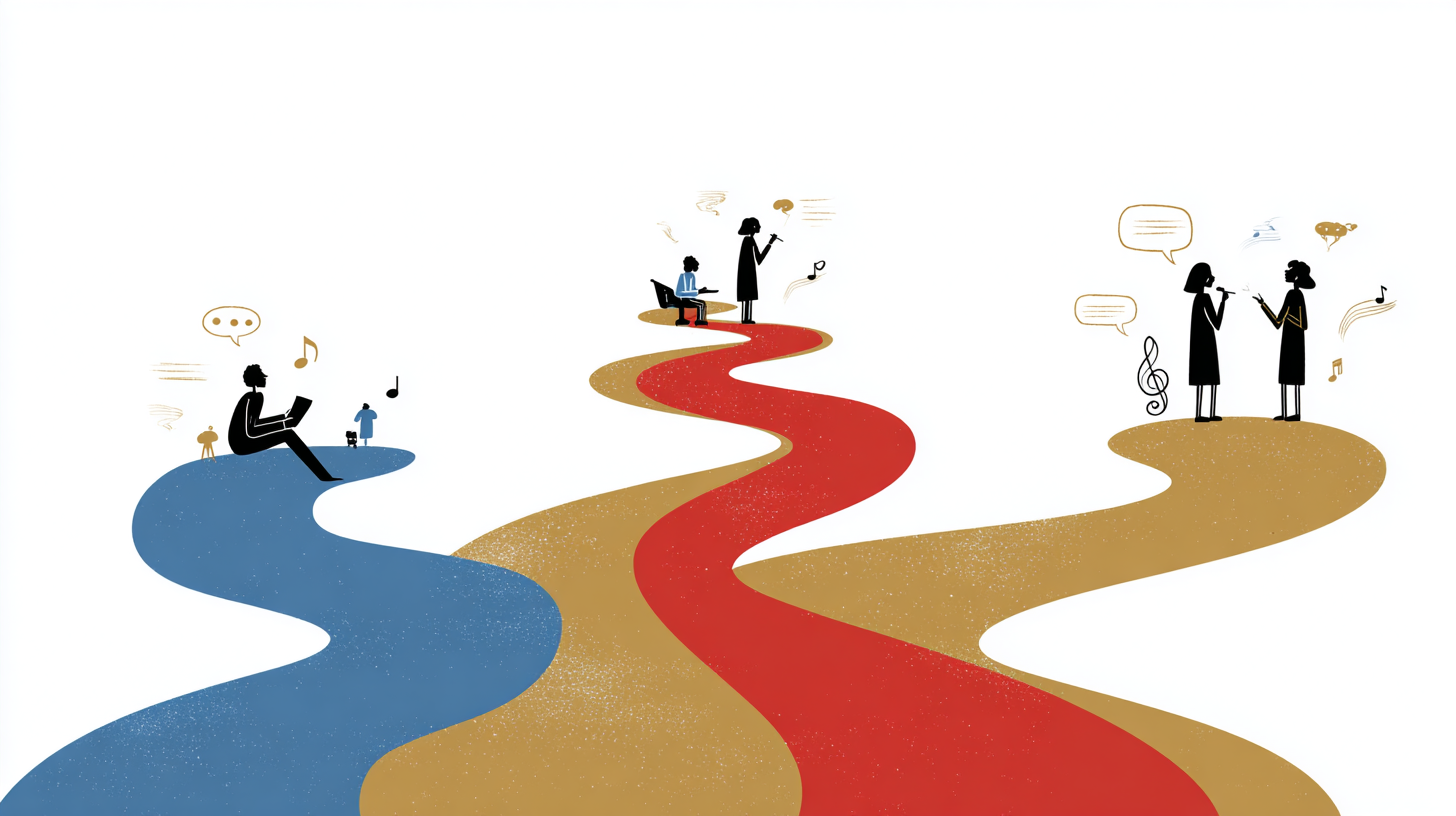
Learning a language is a journey with distinct stages. The problem is that most learners get stuck in the middle — somewhere between understanding and speaking — without knowing why or how to move forward.
This article maps the complete journey from zero to fluent speaker, explains what's happening in your brain at each stage, and tells you exactly what you need at each point.
Stage 1: Building the Foundation (Input Phase)
In the beginning, you need input. There's no way around it. Before you can produce language, you need language in your brain. This is the foundation-building phase.
During this stage, you're filling your Thinking Brain with the basic facts of the language: core vocabulary, basic grammar patterns, pronunciation awareness, and an intuitive feel for how the language sounds and flows.
What works at this stage: comprehensible input methods like Duolingo, Dreaming Spanish, podcasts for beginners, simple reading materials, and classes that focus on understanding. Krashen's approach is particularly effective here — exposure to language you can mostly understand, slightly above your current level.
What your brain is doing: building declarative memory. Storing facts about the language in a system that allows conscious recall.
How long it takes: this varies enormously between people, and the honest answer is that nobody can give you a figure for yourself.
How to know you're ready for the next stage: you can understand the gist of conversations, you recognise common words when you hear them, and you have a sense of how sentences are structured. You don't need to understand everything — just enough that you have a foundation of knowledge in your Thinking Brain.
Stage 2: The Plateau (Where Most Learners Get Stuck)
This is the stage that traps millions of learners. Your understanding is solid and growing. You can follow TV shows, understand podcasts, and read articles in your target language. Your Thinking Brain is full of language knowledge.
But you can't speak.
You know what you want to say, but you can't say it quickly enough. You understand questions but freeze when trying to answer. You recognise vocabulary when you hear it but can't produce it when you need it.
What's happening in your brain: your Thinking Brain is overflowing with knowledge, but your Knowing Brain is empty. The two systems are separate. No matter how much more input you consume, the Knowing Brain won't develop because input doesn't train it.
What doesn't work at this stage: more input. More Duolingo. More Netflix. More podcasts. These all feed the Thinking Brain, which is already full. It's like continuing to pour water into a full glass — the glass can't hold any more.
What you need: output training. A method that transfers language from your Thinking Brain to your Knowing Brain. This requires production practice — actually producing the language, not just receiving it.
This is the critical insight that most learners miss. The plateau isn't a motivation problem, a talent problem, or a study-hours problem. It's a brain-system problem. You've been training one system. You need to train a different one.
Stage 3: Output Training (The Transfer Phase)
Output training is the process of moving language from declarative memory (Thinking Brain) to procedural memory (Knowing Brain). This is where passive knowledge becomes active speaking ability.
During this stage, phrases that you previously had to consciously recall and assemble begin to come out automatically. The gap between thinking and speaking shrinks. You start producing language without conscious effort — the same way you produce your native language.
What works at this stage: repeated production of high-frequency phrases in an emotionally engaging context. The key requirements are that you produce language (not just receive it), the production is repeated enough to build procedural memory, the emotional context is positive (engaging the Feeling Brain), and the anxiety is low (keeping the affective filter down).
Music-based methods are particularly effective here because they meet all four requirements simultaneously. You produce language by singing along. The earworms create involuntary repetition. The music engages the Feeling Brain. And singing removes the performance anxiety of conversation.
What your brain is doing: building procedural memory. The neural pathways for automatic speech production are forming and strengthening with each repetition.
How long it takes: the earworm is the signal to watch rather than the calendar. Once a chorus is looping uninvited the transfer is under way; broad conversational coverage builds from there, at a rate set by how much repetition the songs are getting.
Stage 4: Integration (The Conversation Phase)
Once your Knowing Brain has a sufficient base of automatically producible phrases, real conversation becomes possible — and enjoyable. This is the integration phase.
You can now handle basic exchanges, express needs and wants, and participate in simple conversations without freezing. The foundation of automatic phrases gives you enough to keep a conversation going while you continue to build.
What works at this stage: actual conversation practice. Now that your Knowing Brain has a base, conversation is no longer terrifying. You have phrases you can produce automatically, which gives you confidence. And the gaps you encounter in conversation motivate you to learn more — creating a natural feedback loop between input, output training, and real-world practice.
Continued input at this stage feeds your Thinking Brain with new vocabulary and structures. Continued output training (earworm songs, singing practice) transfers the new material to your Knowing Brain. And conversation practice provides real-world application and motivation.
What your brain is doing: integrating all three systems. Your Thinking Brain continues to learn. Your Knowing Brain continues to automate. Your Feeling Brain stays engaged through the pleasure of real communication.
Stage 5: Fluency (The Autopilot Phase)
Fluency isn't perfection. It's the point where your Knowing Brain handles the vast majority of speech production automatically, and your Thinking Brain steps in only for unusual situations — specialised vocabulary, complex abstract ideas, or unfamiliar topics.
At this stage, conversation feels effortless. You don't translate in your head. You don't consciously conjugate. Language flows in and out naturally. Your speaking may not be perfect, but it's fast, natural, and effective.
What maintains fluency: continued exposure and use. Both input and output. The Knowing Brain maintains its skills through use — if you stop using the language entirely, some automation will fade (though it returns quickly with renewed practice).
Where Are You?
Most readers of this article are somewhere in Stage 2. Your Thinking Brain is full. Your Knowing Brain is empty. You've been told to keep doing more input, but more input isn't solving the speaking problem.
The solution is clear: you need to start Stage 3. Output training. Transfer what your Thinking Brain knows to your Knowing Brain through repeated, emotionally engaging, anxiety-free production practice.
Your learning journey isn't stalled. It's just waiting for the next stage to begin.
About Outputly
Outputly is Stage 3 — the output training that transfers your language from Thinking to Knowing. Our earworm songs provide the repeated, emotionally engaging, anxiety-free production practice that your Knowing Brain needs.
If you've done the input and you're stuck in the plateau, this is your next step.
100 earworm songs. 3,000+ phrases. 95% conversational coverage. The bridge from understanding to speaking.