There's a question that haunts millions of language learners: "Why can I understand so much but say so little?"
You can watch a film in your target language and follow the plot. You can eavesdrop on a conversation and catch most of it. You can read articles and understand the main points. Your comprehension is real.
But ask you to say something — anything — and you freeze. The words are in there somewhere, but they won't come out. Not quickly enough, not accurately enough, not confidently enough.
The explanation lies in one of the most important distinctions in neuroscience: declarative memory versus procedural memory.
Declarative Memory: Your Filing System
Declarative memory is the brain system responsible for storing facts, events, and knowledge that you can consciously recall. It's managed primarily by the hippocampus and the medial temporal lobe.
There are two types of declarative memory. Semantic memory stores general facts: Paris is the capital of France, water boils at 100°C, "casa" means "house." Episodic memory stores personal experiences: I remember the lesson where I learned that word, I recall the film where I first heard that phrase.
When you learn a language through traditional methods — apps, textbooks, classes, or comprehensible input — the information goes into declarative memory. You're storing facts about the language: vocabulary definitions, grammar rules, pronunciation patterns.
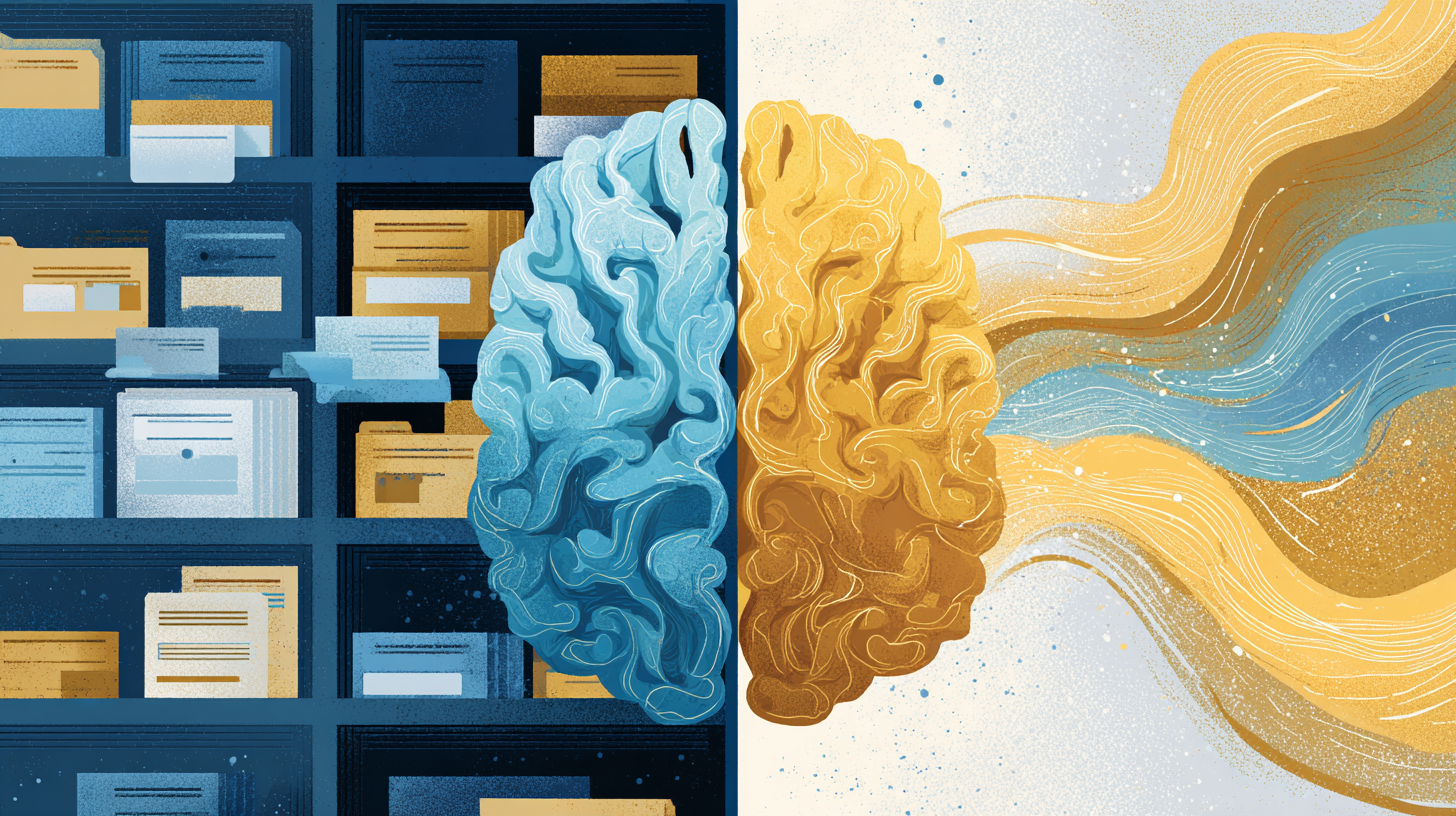
Declarative memory is conscious and effortful. To use it, you have to actively search for and retrieve information. Think of it like a filing cabinet: you know the information is in there, but you have to open the drawer, find the right folder, and pull it out. This takes time.
Procedural Memory: Your Autopilot
Procedural memory is an entirely different system. It's managed primarily by the basal ganglia and cerebellum, and it's responsible for skills and actions that you can perform without conscious thought.
Riding a bike, tying your shoes, typing on a keyboard, driving a car — these are all procedural memories. You don't think about the individual steps. You don't consciously control each movement. Your brain just does it.
The defining characteristic of procedural memory is automation. Once something is stored here, it operates below consciousness. It's fast, effortless, and doesn't require attention or deliberation.
Speaking your native language is procedural. You don't consciously retrieve vocabulary, apply grammar rules, or plan sentence structure. You just speak. Words come out correctly, in the right order, at conversational speed. Your procedural memory handles the entire production process automatically.
The Gap Between Understanding and Speaking
Michael Ullman's declarative/procedural model (2001) established that language relies on both memory systems but for different functions. Declarative memory handles vocabulary and factual knowledge. Procedural memory handles grammar processing and automatic production.
This explains the gap perfectly.
When you study a language, you fill your declarative memory with vocabulary and rules. When you receive comprehensible input, you strengthen your declarative knowledge through exposure and context. Your understanding grows because your declarative memory becomes rich and detailed.
But your procedural memory — the system that handles automatic speech production — hasn't been trained at all. It's still empty for your target language. And declarative knowledge doesn't automatically become procedural skill.
This is the crucial point that most language learning methods miss: knowing something and being able to do it are fundamentally different brain processes. They use different neural systems, different brain regions, and different types of encoding. You can't fill one and expect the other to develop.
Why the Transfer Doesn't Happen Automatically
Many learners and even some teachers believe that with enough exposure and time, declarative knowledge will gradually become procedural. "Just keep practising and it'll become automatic."
The evidence doesn't support this for language. Research by Paradis (2009) showed that the two memory systems can operate independently, and that adult second language learners often rely heavily on declarative memory for production — consciously recalling rules and vocabulary — even after years of study.
The transfer from declarative to procedural requires specific conditions: repeated production in context, emotional engagement that activates consolidation pathways, and reduced anxiety that allows the procedural system to form new patterns.
Simply knowing more facts about the language doesn't create these conditions. You can have the world's largest vocabulary stored in declarative memory, and your procedural system will still be empty if you've never trained it directly.
What This Means for Your Learning
If you understand your target language but can't speak it, there's nothing wrong with your brain. It's working exactly as designed. Your declarative memory did its job — it absorbed the facts you studied. Your procedural memory is simply waiting to be trained.
The solution isn't more vocabulary, more grammar study, or more comprehensible input. Those all feed declarative memory. The solution is direct training of procedural memory through repeated production that's emotionally engaging and low-anxiety.
We call declarative memory the "Thinking Brain" and procedural memory the "Knowing Brain." Your Thinking Brain is full. Your Knowing Brain needs training. And your Feeling Brain — the emotional system that accelerates the transfer — is the key to making it happen efficiently.
About Outputly
Outputly trains your procedural memory (Knowing Brain) through music. Singing along to earworm songs creates the repeated production, emotional engagement, and low-anxiety environment that procedural memory needs to develop.
100 earworm songs. 3,000+ phrases. 95% conversational coverage.